I admittedly only watch a handful of documentaries a year, if that. Documentaries have abounded in the 21st century; Netflix, HBO, and even ESPN have been great for the documentary business. High definition has been a godsend for nature documentaries. Given the proliferation of documentaries, though, it is hard to say that there have been that many game changing docs that have come out during this robust period. Nathan Fielder and Lance Oppenheim have put their best foot forward to make a standout documentary, though, with You Can See Everything, a film that challenges its audience in a way that few docs in the past ever have, if ever.
The subject of this doc is Elizabeth Holmes, of Theranos infamy. The downfall of Holmes and Theranos was one of the biggest stories of the 2010s. Their claim to have a blood-testing device that could revolutionize the medical tech industry became big news. The revelation that it was all exaggeration and empty promises made the fall more staggering than the meteoric rise. Holmes was indicted on fraud in 2018 and sentenced to prison in 2022.
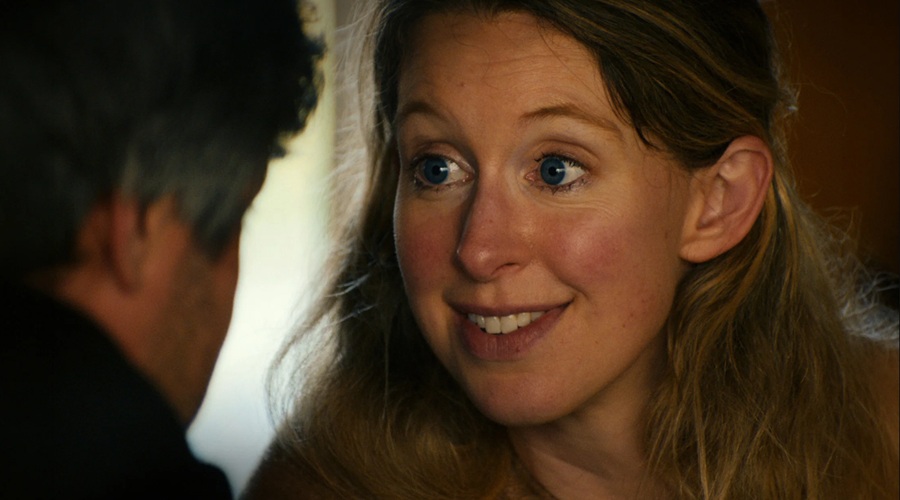
Fielder and Oppenheim’s film opens with the disclosure that Fielder is invited by Holmes and her husband, Billy Evans, to film their lives thirty-three days before she reports to prison for her 11+ years. Fielder is the skeptical avatar of the audience, granted unbelievably intimate access to this family’s life, eventually moving in with them to really immerse himself in the experience. What starts off as a thirty-day immersive expose turns into a much larger odyssey that leaves the viewer questioning everything.
In what I have seen in regards to the promotional material for this film, which is nearly three hours long, most of footage shown is from the time that Nathan spends with the Elizabeth, Billy, and their two kids. That is actually really just the first half of the film, and the second half of the film unfolds while she is in prison and when things start to get really wild. I think experiencing that second half as cleanly as possible makes for the best viewing experience, so I will not touch on much of it. But suffice to say, it is a trip!
Fielder is famous for his Comedy Central show, Nathan for You, a show that blurs reality and fiction for humor. I never really got into the show, but what pieces I saw I enjoyed. It’s the awkward, uncomfortable humor in the vein of Tim Robinson, but with a really deadpan delivery and more based in reality. In that way, it is very ironic (or appropriate, maybe) that he is the one that is on screen running the documentary about Holmes, someone who is still adamant about her innocence.
It is very clear from early on that things are not as unvarnished and the access is not as unlimited as was apparently proposed to A24, the studio behind the film. Billy in two or three short instances shuts down interviews and removes Elizabeth from the situation when things start to get uncomfortable. There is significant poking and prodding by Fielder and the camera crew to push for as much access as they can get, which provides great tension in the film. There are also one or two moments when Elizabeth and Billy forget to turn off their mics, so you can hear a private conversation between them when they have retreated behind closed doors.
Holmes and Evans come across, frankly, as sociopaths, creatures of Silicon Valley that are always on to the point where it seems like there is no real Elizabeth Holmes or real Billy Evans beneath the facade they they present to everyone they interact with. There’s almost an uncanny valley with the way they will stare intently into anyone’s eyes and tell them either exactly what they want to hear or say something to disarm them and manipulate them to their way of thinking.
These two reminded me of two MAGA grifters, Jacob Wohl and Jack Burkman, two men who went in on scheme after scheme after scheme as chronic fraudsters who continually would claim to have exposed something or would ask for money to perform a service, like securing a pardon, and then just pocket the money. The prospect of having an actual job and making an honest living is apparently too abhorrent to them, likely because they’re chasing fame too, so they just keep scheming. Similarly, Holmes and Evans are still trying to find an angle in the medical science field, and refuse to believe that the Theranos promise was a lie. If they put an ounce of effort in what they were doing into real life work, they could potentially do real good in the world. But I guess that might not pay for the life(style) they want. Grifters gonna grift.
Holmes comes across as a mix of delusional, out of touch, oblivious, and willfully naive. In one incredible scene, Nathan plays a famously funny comedy routine for her and Billy, and she pretends to laugh at it after the fact. When Nathan presses her on it however, she reveals that she doesn’t really understand why the comedy routine is funny, the nuance of the comedy is completely lost on her. Also, in the moment, it looks like she can’t process this revelation about herself.
Billy comes across as the villain of the documentary. Initially, he seems to be the protective spouse, trying to shield her from difficult questions and the discomfort of Fielder’s probing. However, as the movie progresses, his manipulative personality becomes more and more apparent, and he shows himself to be as much of a BS artist as Holmes. Two sociopaths finding love(???) in a hopeless place. At least it seems like they love their kids.
Things take a turn to crazy town in the second half of the film, when some new information comes to light and call into question some of what the audience has seen and heard in the first half of the film. As things progress, you eventually lose your bearings in this movie and begin to question how much of this documentary is real and if any of it is fictional and how much of it might be fictional.
With Elizabeth behind bars and unable to be filmed, it is incredible that the film is nevertheless still able to sustain itself over the entire second half with her essentially off screen. At this point, in a brilliant move, a new avatar is brought in for the audience, who questions everything. This person’s presence even brings Nathan under the viewer’s scrutiny and whether he is a reliable narrator. Are his motives pure? Have we really seen everything, as the title says? To say more would be to spoil too much.
There has been a lot of hype and rave reviews for this film. Believe it. You Can See Everything is as good as advertised. It is a documentary about the person at the center of one of the most captivating public downfalls in recent history. But it also a film that deconstructs and examines the format that is documentary film. It is the modern day F for Fake. For a film that say you can see everything, it will leave you questioning everything.
Rating:


Leave a Reply