The Social Network was never my favorite David Fincher movie, but it is great and undoubtedly one of the defining films of Fincher’s career and of the 21st century. Given how Facebook has expanded and morphed itself in the subsequent sixteen years since the release of The Social Network, a sequel was inevitable, it was merely a question was when and how and if it would match the moment like the original did. Now, it is here in The Social Reckoning.
Gone are Fincher as director and Jesse Eisenberg as Facebook co-founder and CEO Mark Zuckerberg. In their place are Aaron Sorkin, the writer of the both films, and Jeremy Strong as Zuckerberg. However, the CEO is merely a supporting role this time around, as the major focus is on a Wall Street Journal investigative reporting that became known as the Facebook Files, reporting that looked into the practices of Facebook that helped feed political extremism in the United States by tweaking its algorithm to supercharge radical content, all in the name of profit.
The investigation begins in 2019 and carries through into 2022, and the Wall Street Journal reporter doing the investigating is Jeff Horwitz (Jeremy Allen White), new to the San Francisco area and the tech beat, to the surprise of both his bureau chief Kris (Betty Gilpin) and his editor Andy (Gbenga Akinnagbe). But Horwitz doesn’t see it as a tech job, but rather a political one because Facebook and Zuckerberg are playing an increasingly outsized role in the lives of everyday people. He begins shaking the proverbial Facebook trees to see what shakes loose.
What he finds is a concerned employee in the form of Frances Haugen (Mikey Madison) who reaches out to him when her concerns fall on deaf ears internally. As a member of the Civic Integrity team, she is alarmed when she sees a video of a high school friend who has a viral interaction with the police, portrayed by Portia Doubleday in the opening scene of the film. Trying to reconcile the person she knew with the person she sees in the video leads her to look at her company and their role in radicalizing her.
The film hops around on the timeline from 2019 to 2022 and all points in between, including tackling the rise of Covid. Most of the scenes involving Zuckerberg occur in 2021, during a prep session in advance of a Congressional hearing regarding content management. This prep includes coaching from a crisis manager (Wunmi Mosaku) and a former Facebook investor and Zuckerberg antagonist (Bill Burr) giving him feedback. Their work eventually has to take a backseat to two real-time events, their head of PR (Billy Magnussen) breaking the news to them that the WSJ is going to publish and a rapidly developing political news event in D.C.
The acting in the film is strong; Madison and White play off of each other very well and handle the jargon and wittiness-heavy dialogue they share beautifully. I think the gold standard of witty banter between two characters is probably His Girl Friday, and they’re in the ballpark of that a few times because the dialogue is coming fast. Both are blunt and a little acerbic and snarky with each other, but they still manage to maintain a professionalism and determination in their pursuit of the facts and the story.
While I appreciated and enjoyed their banter and their growing respect and appreciation for one another, a scene toward the end of the film felt oddly jarring and tonally off, where there is almost a romantic tension to the scene in a gesture that one of them makes toward the other, tension that I do not think was intentional. Sorkin is a great screenwriter but his directorial efforts have been more of a mixed bag, and I wonder if this was something his eye missed that a more experienced director (like Fincher) might have noticed.
I thought that making Frances’ decision to become a whistleblower because she was a “true believer” in Facebook worked narratively. She has reasons why she believes that the platform, in its best form, can be a source of improving lives, and those reason feel authentic to her as a character. And that belief is not tarnished or disillusioned but it spurs her on to do what she does. And as Horwitz tells her, often for the big changes to happen, it has to hurt. Basically, the company needs to touch the stove.
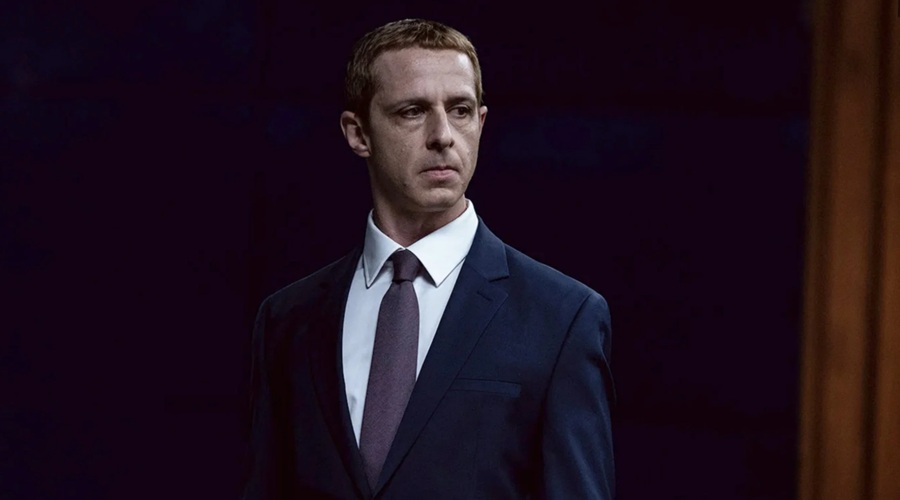
Jeremy Strong as Mark Zuckerberg is about as solid an actor to take on the role outside of Eisenberg as you could hope for, but it feels like there is almost too much overlap or lingering carryover from Kendall Roy in Succession. His Zuckerberg feels more alien and isolated than Eisenberg’s ever was, robotic and detached from much of the world around him. Maybe this is a practiced detachment, because it is easier to be a CEO of one of the biggest companies in the world. If it is a facade or a wall that he has put up, real-life events eventually reveal how it is not impenetrable; sometimes the world is going to impose itself. In the case here, his perception that the company is in a no-win situation when it comes to the discourse on content moderation is not solved by simply ignoring the question and choosing to turn a blind eye or throw up your hands.
Does The Social Reckoning meet the moment like The Social Network did? Unfortunately, I think it falls a little short. The first film felt like it exposed something, like it peeled the curtain back and showed how the sausage was made and how things behind the scenes were more than a little unseemly in this meteoric rise of the social media platform that was a worldwide phenomenon.
The Social Reckoning is an alarm bell blowing the whistle on some serious issues. In particular, the way that social media is shaping us, influencing us, changing us, and the dereliction of Facebook when it comes to any moral responsibility they have over their platforms and the content that people put on there and the choices they make that amplify certain content over others. I also felt the unsettling pit in my stomach reliving and hearing a lot of the discussion about content moderation that I heard and read in the last decade, but that made me realize that the film is mostly preaching to the converted. And given the reactions that billionaires like Zuckerberg had after the 2024 election, this rehashing or bringing to light what happened in the late 2010 and early 2020s feels inadequate for the world we currently find ourselves in. There’s a “too little, too late” feel to a lot of this.
And maybe this choice was done so as to not alienate some viewers, but the movie makes a point to not say Donald Trump’s name in several pivotal moments, even though everybody knows who they’re talking about because of the day and the events unfolding. Choosing to treat him like Lord Voldemort is an odd choice to me.
As great as Sorkin’s writing can be, some of the writing here feels a little lazy too. Movies about investigative journalism can weirdly feel like a hospital procedural, playing detective and searching through documents is similar to trying to diagnose and find the root cause of why someone is sick in medicine. Here, when Frances and Jeff both have an “ah ha” moment when they realize what is driving the algorithm, and it’s treated like they’ve discovered the root cause of the disease, but the answer already feels rather obvious.
Making a sequel to one of the most important modern films is no easy task and probably an impossible standard to live up to. In that regard, it is commendable for Sorkin and company to even dare try to follow in the footsteps of The Social Network and make a sequel that can be its own thing because the comparisons are unavoidable.
While it is not The Social Network and it isn’t quite up to the impossible task of measuring up to it, The Social Reckoning does still have some real strengths to recommend it. I think it presents a lot of big, important ideas about social media and national discourse in a way that is more condensed and digestible for most people. And Madison and White work well when they’re paired together. It may not capture the zeitgeist like the first one did, but it’s a solid procedural about strong journalism. That’s still something.
Rating:


Leave a Reply