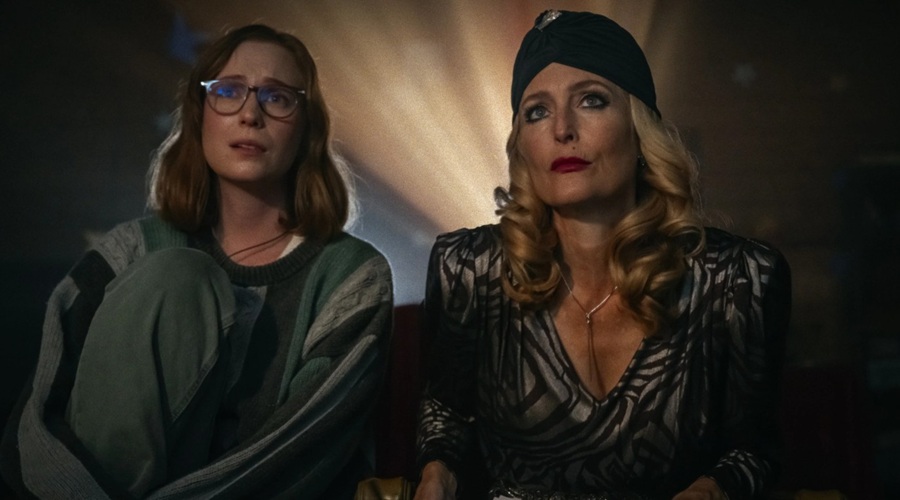
Writer/director Jane Schoenbrun has become a critical darling this decade, with three distinctive films to start out their career as a director: We’re All Going To the World’s Fair, I Saw the TV Glow, and now Teenage Sex and Death at Camp Miasma. Teenage Sex and Death at Camp Miasma is another impressive step forward from the writer/director, building off the promise of the two earlier films.
A clear theme emerging from Schoebrun’s work, aside from the obvious ones about exploring trans identity and sexual identity, is one of how obsessions change and shape a person. With We’re All Going To the World’s Fair, it was online obsession with online horror legends. With I Saw the TV Glow, it was TV show obsessions. Now, with Teenage Sex and Death at Camp Miasma, Schoenbrun is tackling obsession with horror movies and horror franchises.
Kris (Hannah Einbinder) is an up and coming director whose indie flick has caught the eye of a major studio looking to revive a tired and played out slasher franchise that sprouted up around the time of Freddy and Jason in the 80s. Driven into the ground by mindless sequels, Kris is eager to take it on and give it a fresh perspective, but is also mindful of the studio choosing her as the person to do it because, as a queer director, they can use her has a human shield to deflect accusations of misogyny and homophobia that have plagued the franchise through the years.
As part of Kris’ desire to do right by a franchise she saw at a far-too-impressionable young age and fell in love with, she seeks out the reclusive star of the original film, Billy Pressley (Gillian Anderson), who has secluded herself at the camp ground where the original Camp Miasma was filmed. As Kris and Billy spend a few days together, fantasy and reality begin to blur.
Having seen all three of Schoenbrun’s films, I can that I am cooler on them than most film critics as both of their previous two films have found places in multiple “Best Of” year end lists when they came out. I suspect that this one will receive even more acclaim. What has kept me at arm’s length so far has been the Lynchian influences; movies with “dream logic” just are not my jam and I struggle mightily with them. I just could never get on the right wavelength with Lynch, and while I’m closer when it comes to Schoenbrun, it still eludes me.
While I may not be enthusiastic about their work to date, there is simply no denying the talent on display in the craftsmanship of Schoenbrun as a writer and director. I was especially impressed with the visual aesthetic on display in the movie, particularly when it came to the scenes set at the camp. It looked like a studio set, but one exquisitely created to pop and look like an enhanced version of reality with starry skies, snowcapped mountains, and lush pine trees backdropping many scenes. They looked like something out of a classic 50s movie (A quick Google search tells me that five painted glass backdrops were used).
While I love the visual quality of this film, perhaps what I like and appreciate the most about this film is the unabashed love that is on display for the genre and that comes through in nearly every aspect of the film. There is a head knowledge and heart knowledge of horror at work.
The film cuts back and forth several times between the present day with Kris and Billy talking about the franchise and to footage from the original Camp Miasma, which they watch together. There are knowing winks and nods to film geekery (“Split diopter…”) and conversations that are also a little meta. At one point, Kris goes into the deeper meaning and significance of certain aspects of Camp Miasma, and when she’s done, Billy undercuts that a little by saying that, while that is the meaning that Kris and others may have taken from it, ultimately, the movies was just about two things, flesh and fluid.
Horror is a genre that captivates and titillates, but so much of it also operates under a kind of puritanical doctrine of punishment; when characters misbehave, they are punished for their actions by the slasher. Sex and death are synonymous with one another in horror, as famously pointed out in Scream; if someone loses their virginity in a horror movie then it’s curtains for them.
Because of this, it is apt for Schoenbrun to use the genre to explore how our popular culture intake shapes us and can act as road signs for navigating different parts of life and growing up. Art can hit us differently at different ages. Kris talks about seeing the original movie with fresh eyes after watching it with Billy, which is different from when she first saw it when she was a little kid. How we change can impact our relationship to art. Seeing the original movie for the first time after going through sexaul awakening in Kris’ case or transition like Schoenbrun can lead to a new perspective. Sometimes that opens our eyes to new realities, for better and worse. Hannah is quite inspired by her slow spiral of getting lost in Camp Miasma lore, while in I Saw the TV Glow, Owen watches an episode of The Pink Opaque years later and is shocked by how cheap it looks compared to his memory of it.
A rather clever nod to the connection between sex and death in horror is that the slasher of the Camp Miasma franchise is named Little Death (Jack Haven). which is English for the French phrase le petite mort, which is a euphemism for an orgasm. Little Death is a killer with a air vent for a helmet, which I think is its own kind of symbolism about disassociating during disappointing sex.
There is also a weird and lovely blending of the high brow and low brow in this movie, particularly when it comes to food. Kris loves convenience store candy and junk food. When Kris arrives, Billy serves KFC for dinner. At one point, I think when reality starts to go sideways, there’s some kind of shrine or decoration in a bedroom made out of candy wrappers. In Schoenbrun’s world, the high concepts of what a flesh and fluids movie like Camp Miasma is saying fits right beside the ultra processed foods that may have been a staple of moviegoing when you were a kid.
As I have written this review out, I have come to the realization I liked Teenage Sex and Death at Camp Miasma more than I initially thought. I still have a hard time connecting with Schoenbrun’s tone as a filmmaker, but I was to continue to see films from this auteur; even if I struggle with them, they are challenging and thought-provoking nonetheless.
Rating: 3.5 out of 5 stars
 JONESING FOR FILMS
Leave a comment