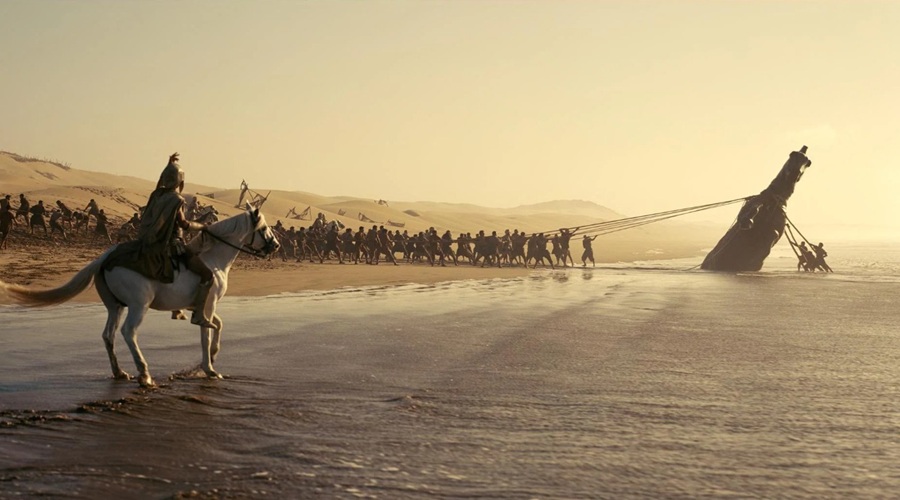
Christopher Nolan has been working in “epic” territory almost exclusively dating back The Dark Knight, culminating in an Oscar triumph with 2023’s Oppenheimer. It only makes sense that he would turn to one of the foundational ancient texts of western civilization for his follow up, adapting Homer’s epic, The Odyssey.
The tale of Odysseus (Matt Damon) and his men trying to return home to Ithaca after the Trojan War is one of the most well-known stories in human history. While off at war, his queen, Penelope (Anne Hathaway), and their son, Telemachus (Tom Holland), await his return, but over the years the King’s dining hall has filled with suitors for the queen’s hand, none more conniving than Antinous (Robert Pattinson). Having angered the gods, Odysseus’ journey home is waylaid by many obstacles thrown in his path while the numbers of his men dwindle and the hopes for a reunion with his family fade.
For an ancient tale that is steeped in mythology, Nolan’s interpretation of this classic is surprisingly bereft of gods and goddesses. However, the film does open with words to the effect of, “A time of apparent magic.” What representatives of the gods there are, most are in the form of goddesses and nymphs. Calypso (Charlize Theron) hides him away on her island to forget his past and his pain, only to eventually help him piece back together his past. Circe (Samantha Morton) curses his men with her witchcraft, but eventually gives him a glimpse into what awaits him and his men on their path. Lastly, Athena (Zendaya) haunts him off and on throughout the film, with an eventual reveal why that goes back to the night of the fall of Troy.
Zeus and other gods are namedropped frequently, but the most prominent role that Zeus plays is in the regular referral to Zeus’ Law, which is a play on the golden rule, which is to welcome the stranger and show them hospitality, for they may be a god in disguise. Given how frequently mythological tales involve a god posing in disguise as a human, it’s a practical custom. This custom comes up frequently in the plot, whether it be in the suitors in Odysseus’ hall taking advantage of Penelope and Telemachus’ hospitality or even in relation to Odysseus and his Trojan Horse could be interpreted as taking advantage of this custom.
The Odyssey contains most of the trial and tribulations that Odysseus and him men go through after leaving Troy. In addition to the encounters with Calypso and Circe, the journey crosses paths with the cyclops, the lure of the sirens, and, maybe my personal favorite back in high school, having to navigate through Scylla and Charybdis. The siren scene is particularly well done, and how Odysseus describes it to his men after the fact about the extremes of ecstasy and torture their song produced is particularly great dialogue.
Weaved throughout the story of Odysseus is the larger tapestry of the fallout from the Trojan War, some of which is shared with Telemachus and his search for answers as to the whereabouts of his missing father. He travels to see Menelaus (Jon Bernthal) for word, and there gets to meet the famed Helen (Lupita Nyong’o) that launched a thousand ships, or, after the cruelty of Menelaus, might only launch five hundred at this point. Nyong’o portrays not only Helen, but her sister Clytemnestra, who is married to the brother of Menelaus, King Agamemnon (Benny Safdie), the ruler of the Greeks. I was particularly fond of the way Nolan chooses to portray Agamemnon, whose face and form, hidden behind imposing armor, is never fully seen by the viewer. It makes the way his fate plays out all the more effective.
This film is also chock full of acting talent that there are almost too many to get into. Elliot Page gets a slightly expanded role in Sinon, particularly in the haunting visit to the underworld, which also has a great little part for James Remar. Bill Irwin is unrecognizable, obviously, as the cyclops Polyphemus. Himesh Patel is Odysseus’ right hand man Eurylochus. John Leguizamo brings a surprising level of gravitas to the role of Eumaeus. Of the more major roles, Pattinson is having a blast playing Antinous as a pure reprobate. I thought Anne Hathaway was an incredibly powerful performance as a resolute woman surrounded by a brood of vipers.
The fallout of the war is a major theme of the film and a significant point that Nolan is trying to make with this film. Odysseus carries a significant amount of guilt over his actions and his decisions. He is widely acknowledged by all as being the smartest of leaders in Agamemnon’s forces. And he carries the weight of that knowing full well that his decisions will cost lives. He grapples with the responsibility of knowing from Circe that he may have to sacrifice some men to save the rest. He is a character that carries a burden. There are echoes of J. Robert Oppenheimer in Damon’s Odysseus. Oppenheimer, the subject of Nolan’s previous film, was burdened by the notion that he may have created society’s fall.
Nolan also seems to be challenging the famous Francois Truffaut quote that there’s no such thing as an anti-war movie and all war movies end up being pro-war because they end up glamorizing war. Nolan uses Homer’s tale to grapple with the fallout of war, how it changes a person and how it marks the world and forever alters history, on a grand scale and a personal scale. Damon gives a emotionally heavy speech recounting Odysseus’ experience and what he witnessed during the fall of Troy. It is one of the few moments in all of Nolan’s filmography that made me genuinely choked up. It’s a message that echoes through time and still has resonance today, thousands of years after the events are supposed to have taken place.
It is odd that a definitive feature film adaptation of The Odyssey has never been made before, but as a podcast I listened to noted, it may just be that the means to do so never really existed until more recently. Nolan, in his own unique way, weaves together a nonlinear narrative to splice together a compelling adaptation (you could read “interpretation”), culminating in a frenetic ending of vengeance and justice. It is also a tale that is told at an appropriate scale of size and scope, grandiose in its design. It is intended to be seen on the big, nay, the biggest of screens, and it lives up to that ambition. Out of all of the great directors currently working, The Odyssey feels like it only could have been done by Christopher Nolan, because he’s working in a register that no one else is.
Rating:


Leave a Reply