I recently began rewatching The X-Files, my favorite show when I was a teenager back in the 90s. I loved the alien mythology and conspiracy at the heart of the series. While I’m not sure I believe in the existence of extraterrestrials, I have always been captivated by the possibility and the sci-fi that has sprung up around the notion that we are not alone, and I’m not alone in that.
Steven Spielberg has been someone for me and countless others who has shaped that sense of wonder in what is out there with the influential Close Encounters of the Third Kind and E. T. The Extra-Terrestrial (and to a lesser extent with his adaptation of War of the Worlds). Now, Spielberg is returning to the well-worn paths he paved decades ago with a more grown-up, conspiracy-heavy Disclosure Day.
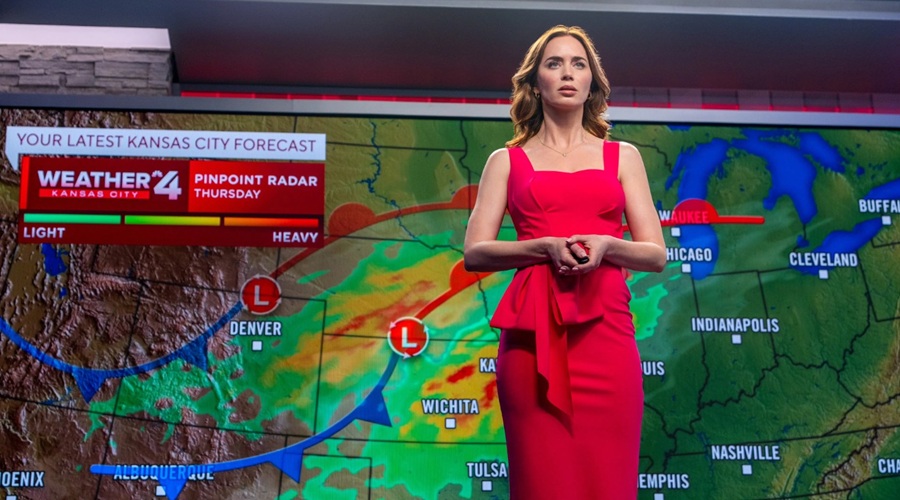
The film opens in medias res, with cybersecurity expert Daniel Kellner (Josh O’Connor) making an exchange at a wrestling event of highly classified information he has stolen in return for Jane Blankenship (Eve Hewson), his girlfriend. He manages to secure her release and their escape by utilizing a mysterious handheld device. In Kansas City, local weatherwoman Margaret Fairchild (Emily Blunt) has an episode while delivering the morning weather report, uttering strange and inhuman sounds. Like Daniel and Jane, Margaret soon finds herself on the run from a shadowy government organization, headed by Noah Scanlon (Colin Firth), an organization intent on keeping secret the biggest of secrets, 80+ years of evidence of the existence of aliens.
Where Close Encounters and E.T. were more focused on the awe and wonder of life from other worlds visiting ours, Disclosure Day is much more focused on the human and government response and sustained effort to cover it all up. At the heart of much of alien conspiracy theories is a tension centered on how people would react to that knowledge and how much of a paradigm shift it would be to find out that we are not alone. How would such knowledge change our understanding of our planet, ourselves, and our beliefs. Basically, can humanity handle the knowledge or not?
As the head of an organization named Wardex Corporation that has maintained the secret for decades, Firth’s Noah is of the mind that it would be too much for people to handle. O’Connor’s Daniel is of the mind that it is no one person’s or organization’s call to make that decision for the 7 billion people on the planet. Aided by a former counterpart of Noah in Colman Domingo’s Hugo Wakefield, Daniel seeks to make the secrets public and let people decide for themselves. Spielberg has always been an optimist as a filmmaker, so the film ultimately falls in one direction when it comes to assessing humanity.
This is a blockbuster, but there is little in the way of significant set pieces or action sequences; the closest comes when Daniel and Margaret’s paths finally cross and the vehicle they are in is pushed into the path of an oncoming train. There are car chases and Noah is constantly on the hunt using surveillance and alien technology to track down Daniel and Jane. The mysterious handheld device is a dangerous weapon, potentially lethal to humans, but can be used as a kind of telepathic device. There is a masterful scene where Noah, from the confines of Wardex, uses it to have a conversation with and get into the mind of Jane when she and Daniel are hiding out in a remote cabin.
The film aims to keep a propulsive feel to the action from the start, but some of the action and story beats feel contrived, are clunky, or just beggar belief. Daniel has to leave a remote cabin that he and Jane are staying at to make a phone call because he has no reception. While gone, authorities pull up and surround the cabin with Jane inside. Daniel sneaks up to commandeer a police car in the least subtle way possible. Later, as they are being hotly pursued by agents on their tail in that same vehicle, they manage to put enough distance between them and the pursuing vehicles to fake jumping the car into a lake and sneak away, again, in a manner that does not sound sneaky.
Disclosure Day is at its best in the interpersonal moments that happen between characters that are in conflict or tension with one another, conversations between Daniel and Jane about their respective pasts, Noah and Hugo having a debate about their opposing viewpoints, or the cabin scene where Jane is trying to resist Noah’s psychological probing.
The film aims for lofty ideas and lays out plainly the inherent risks that Daniel and his cause are taking by trying to disclose the truth to a world that is on the brink of war and might not be ready for it. Some of the questions it asks end up being ones that, frankly, I thought were answered poorly, particularly when it comes to how Spielberg and screenwriter David Koepp attempt to tackle the ramifications alien life would have on religious beliefs. Koepp and Spielberg’s film is not nearly as deep on these matters as they seem to think it is.
Lastly, the film suffers from the self-imposed burden of needing to be a “movie with a message” at the end, in the vein of 80s movies like The Abyss or 2010: The Year We Make Contact. There is a message in here that is legitimately good, a message about empathy, that is universal and for everyone, to be sure, but in the end, despite a pretty thrilling montage of disclosures, that message comes across very heavy-handed. Having said that, though, the last word of the film ties in rather perfectly with the message of empathy.
Despite suffering from “Movie with a Message” syndrome, I think Disclosure Day is still a movie worth seeing; even if it never quite reaches the heights of Spielberg’s best until maybe the end, it has a positive message about humanity and our place in the universe, even if it delivers it in a ham-fisted manner at times. Its aim is admirable.
Rating: 3 out of 5 stars


Leave a Reply