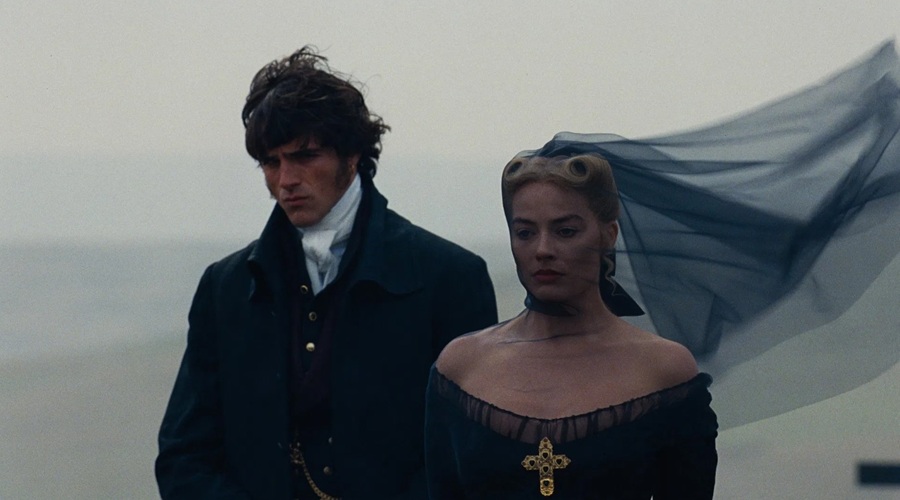
Wuthering Heights is a core English lit classic that I somehow managed to miss in high school and never caught up with as an adult. Therefore, I do not have the source material as a comparison to judge Emerald Fennell’s lush adaptation. I’ve also never seen any of the many previous adaptations of the novel either, so I came into this viewing largely unfamiliar with the tale outside of a few broad strokes.
This adaptation of the Emily Bronte classic apparently eschews several elements and characters in the book in favor of focusing on the tragic love story between Margot Robbie’s Cathy and Jacob Elordi’s Heathcliff. As young children, Heathcliff is brought to Wuthering Heights by Cathy’s father, Mr. Earnshaw (Martin Clunes). Unofficially adopted by the family, Cathy and Heathcliff quickly become closest confidants of one another, with Heathcliff early on showing that he is smitten with her.
As adults, however, their love is challenged by circumstances, social rank, as Cathy chooses to marry another man, the opulently rich Edgar Linton (Shazad Latif). Shattered, Heathcliff disappears for five years before eventually coming back into Cathy’s world a changed man.
When Cathy first encounters her new neighbors, the Lintons, she overhears Edgar’s sister Isabella (Alison Oliver) recounting the tale of Romeo and Juliet. The reference to Shakespeare’s tragic love story is instructive. My understanding of the Bronte novel is that it is gothic romanticism, yes, but it is also a story about class told over multiple generations. Beyond Catherine’s drunk and abusive father, Mr. Earnshaw, much of the generational elements of the story have been excised from the film. Fennell’s true focus here is on Heathcliff and Cathy and playing out their own version of ill-fated lovers like that of Romeo and Juliet.
Fennell and company go big and bold in portraying the love story, such that it is, between the two. For the actors, these are characters that feel primarily driven by their emotions and their passions, so passionate that they can appear incredibly hateful toward each other one moment and ready to tear clothes off each other the next. There is an added layer of steaminess that I suspect is not to be found in the source material, with some BDSM and voyeurism added to the mix.
Elordi is brooding and towering, physically imposing and in stark contrast to Robbie in that regard. Heathcliff is a hardened man, someone who is basically tormented by his love for Cathy, which causes his to do cruel things at times. Robbie’s Cathy is a slightly spoiled woman who is too careless with her words and brash in her decisions, realizing their consequences too late. She also takes Heathcliff for granted until he leaves, perhaps not realizing the sway she has over him. When he is first brought to Wuthering Heights as a boy, her father says that he is her new “pet” and for most of the film he behaves much like a puppy for her.
Nevertheless, there are some tender moments between the two characters. There’s a sweet scene between the child versions of the characters where he reaches out from hiding under his bed to grab her ankle, and it is a moment of comfort and connection between them, an image that is beautifully recreated later in the film.
The visual language of the film is that of grand imagery, evocative sets. There are plenty of shots featuring the windswept vistas of the moors of England that the story takes place in, and those have a built-in grandiosity to them. The Wuthering Heights estate itself is very dark and brooding, with a pervasive dampness. The Linton estate is pure extravagance, especially the food but also the clothes and the rooms. One particularly funny yet unsettling joke is the color of Cathy’s bedroom walls, which I will not spoil here. It is a lush film, inspired by the likes of Baz Lurhmann and Tim Burton, but also some distinctive, heavily red-hued scenes that I think were strongly influence by both Gone with the Wind and Bram Stoker’s Dracula.
The are some small, anachronistic touches to the film as well, most apparent in a montage scene showing how Cathy spends her time at the Linton estate during the five years that Heathcliff is out of her life. One image that stands out from this is Cathy wearing very modern sunglasses. Of course, the film is set to the music of Charlie XCX, so that also gives the film a more modernized tint.
In the grand gestures of the film, there is some sloppiness though. Some deception and manipulation by other parties is involved in the separation of Cathy and Heathcliff and the motivations for that are muddy. Also, anything involving class is only in the plot here in service to the romantic tensions and nothing more really. It’s also odd that Heathcliff’s fortune is never explained, he just comes back into the picture all wealthy and mannered.
Not being sure what to expect going in, I was surprised that I liked Wuthering Heights more than I had expected to based on the impression I had gotten of it from friends who were familiar with the novel. But the tragic love story between Heathcliff and Cathy is also a bit too tempestuous and manic to be fully engrossing. Chests are heaving and there is much breathless panting, and some vivid imagery, but I was hoping for a bit more pulling of the heart strings than I ultimately got from this tragic romantic drama.
Rating: 3 out of 5 stars
 JONESING FOR FILMS
Leave a comment